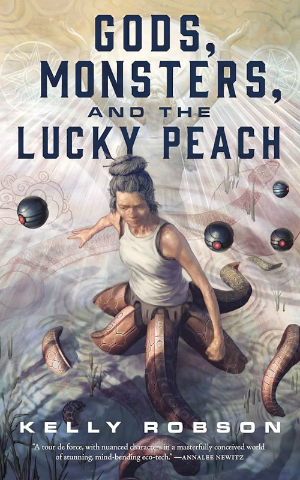
Full of a breathtaking swirl of interacting currents that guide a future world fraught with terrible circumstances and financial motivations that are deftly illustrated as out of step with humanity and purpose. The main character, Minh, fights the banks that hold her world at a stalemate, hoping only for adventure--a journey that will take her through time into ancient Mesopotamia. She is driven, to a fault made evident by her influence on others. Her insistence on involving herself, being an important part of the world around her, so much bigger and made much more confusing by disaster, creates a poetic image of the very human desire to conquer, to control the uncontrollable.
This novel is about time travel, an idea of how it might be used by corporations to get ideas about projects, which seems accurate to how we might use it if it were invented. This observation, as well as many others made that resonate with our problems with AI and the dystopian future we are rushing into, make this a clear observation of an all-too-possible future. In this story, people communicate through artificial versions of themselves, "edit" together job interviews rather than have an ordinary conversation with their potential employers, and fabricate resources like water. I don't think, if we experience calamity in the future, that we would be able to create such a technologically advanced world. Much of what the book describes seems to be analougous of what is dooming us now. However, such makes the work more interesting, to imagine what we might build from the ashes.
Many things in this story are left, poetically, to the reader's imagination--the effects of time travel, the operation of the organization that seeks to improve the world by its use, and ultimately the folding of mortality--the inability for one person to hold the entirety of the world's possibility--governed by fate, and reflective of the whole. Noone can hold the world, no world can hold the universe, and what contains the universe is ultimately a mystery. This is reflected in the two stories implicated here by the future meeting the past, the two time-lines that run together throughout until they are inextricably bound by the end of the story, where Minh's fate is ultimately settled.